Other posts
- 24 Jun 2026 » Browslatro: I built a Balatro clone to relearn frontend
- 03 Mar 2022 » Job search is over, I'll be joining ActBlue
- 16 Feb 2022 » The perfect guest appearance (for me)
- 10 Feb 2022 » Bro do you even code
- 08 Feb 2022 » Boundaries
- 06 Feb 2022 » The perfect interview (for me)
- 26 Jan 2022 » Documenting my job search
- 08 Sep 2015 » XSS to RCE in ...
- 25 Jul 2014 » Twitter's CSP Report Collector
- 13 Dec 2013 » Automatic XSS Protection With CSP: No Changes Required
- 13 Jan 2013 » Removing Inline Javascript (for CSP)
Browslatro: I built a Balatro clone to relearn frontend
Play it here (code on GitHub). No install, no account. BYOK if you want to leverage AI for more than a few choices (ML content is free). Desktop or iPad strongly recommended; mobile is playable but cramped.
I’ve spent most of my career in security and backend-adjacent work so my frontend skills had gone stale. CSS still humbles me. So I picked the most over-engineered way imaginable to brush up: I built Browslatro, a browser implementation of Balatro, the poker roguelike that ate my year (C++ gang rise up).
It started as “relearn React” doing things entirely by hand. It ended as a React 19 app with a deterministic scoring engine, two independent move advisors, and an offline machine-learning pipeline that trains a neural network in PyTorch and runs it in the browser via WASM. Towards, the end, it was almost entirely done using Claude.
I would classify this as “90% complete, 60% done.” Some aspects, e.g. some decks, are not implemented at all. While all 150 jokers are represented, I’ve found plenty of bugs (the joker backfill was my exploration into just letting Claude do its thing). Most of the mechanics should be implemented, but I would be shocked if they perfectly aligned with the popular video game. If I were to start over, I would have moved with more caution. However, I had a blast so #NoRagrets.
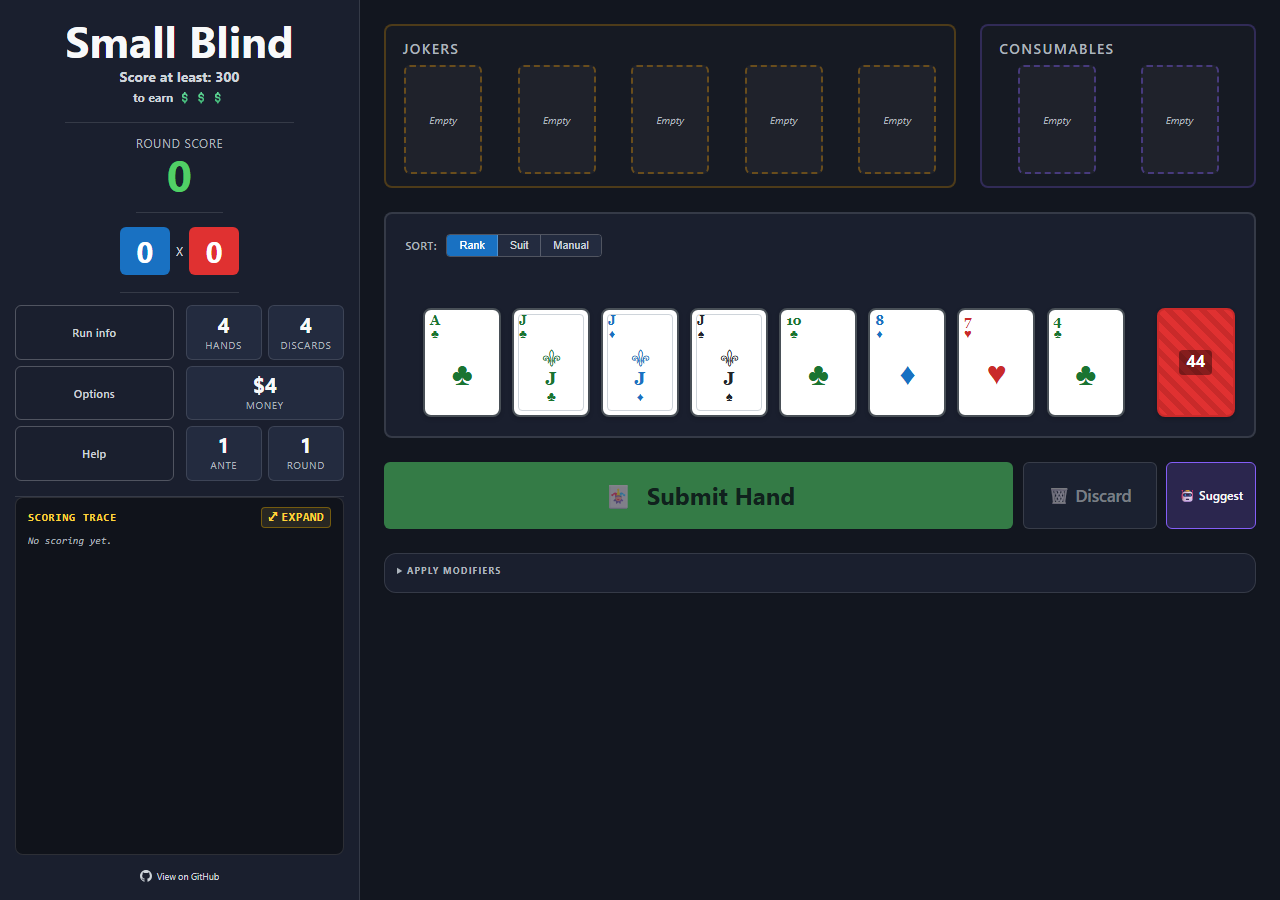
The bonus features (the fun part)
The game itself is “just” a Balatro clone. It would be helful to have some Balatro experience for the rest of this post.
The Scoring Log — show your work
Balatro’s scoring is famously a black box of chips and multipliers ticking up faster than you can follow. The “Scoring Trace” panel (bottom-left, hit “Expand”) breaks down every hand line by line: the base hand’s chips and mult, every joker and enhancement that fired and in what order, the money you won, and the floored final total. It’s the feature I reach for most when a hand scores way more (or way less) than I expected.
The Coach — an instant, free, offline advisor
See that “Suggest” button? Click it and a Coach pops up with the move it thinks is best. The Coach is a tiny neural network — a 3-layer multi-layer perceptron — running entirely in your browser via ONNX Runtime Web. It’s instant, free, and works offline. It never phones home.
The AI — Claude, when you want the “why”
So there’s a second advisor. Hit Ask AI and the request goes to Claude (claude-opus-4-8) through a serverless function, and you get back something the Coach can’t give you:
- a (potentially new) recommendation,
- a plain-language explanation of why it wins,
- the most tempting alternative and why it’s actually worse, and
- one transferable concept you can carry to your next run.
The system prompt makes it an educational coach, not just a solver. The single most important rule in the whole system: numbers flow in exactly one direction — engine → prompt → explanation. Claude may only quote chips, mult, and money figures that the engine already computed and put in front of it.
The machine learning, briefly
The Coach is an imitation-learning student trained offline, and the pipeline is a genuinely fun bit of engineering:
- A headless engine plays full games with no React and no UI, driven by a single seeded RNG so every run is perfectly reproducible.
- A Monte-Carlo search expert generates the training labels — for each decision it shuffles the unseen cards (it can’t cheat and see what you can’t), rolls out several futures, and picks the action with the best average outcome. It’s not a neural net; it’s the “teacher.”
- Real human play (mine, and anyone who exports theirs — more below) gets captured in the same schema and mixed in at a higher weight, so the model learns from actual play, not just synthetic self-play.
- A PyTorch trainer (
ml/train.py) learns to rank candidates. - A benchmark pits the new model against the old one across disjoint random seeds. It only ships if it actually wins on “average blinds cleared.”
There’s a separate model for shop decisions, and an offline knowledge-distillation path where Claude acts as an expensive teacher that relabels exactly the states where the cheap student is weak. However, this often did not lead to meaningful improvements (something I intend to explore in the future).
Your plays can train the model
This is the call to action, and the loop that makes the whole thing tick: play the game, then export your plays.
Open “Apply Modifiers” (the dev panel under the hand) and you’ll find a human-play log. Every decision you make is recorded locally — hand plays, discards, shop purchases, pack picks, skips — and “Export log” dumps them as a JSONL file in exactly the schema the training pipeline ingests.
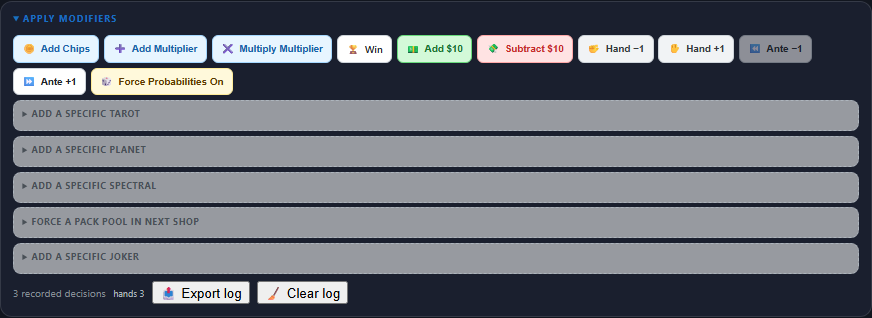
Play a run, export it, send it to me, and you’ve contributed to the next model!
The technology
A quick tour of what’s under the hood:
- Claude** — both as the in-game AI advisor (
claude-opus-4-8) and as the pair-programmer that helped me build practically all of it. - React 19 + strict TypeScript + pnpm (for fast worktree support).
- Zustand for state — a thin, sliced store driving the entire game loop, with pure rules kept separate from components.
- Vite + Vitest + Playwright for build, unit tests, and end-to-end tests.
- Storybook — every component has co-located stories covering its visual states.
- i18next for internationalization, with accessibility treated as a hard requirement, not an afterthought. English and ʻŌlelo Hawaiʻi are supported (waiting on complete translations for now).
- ONNX Runtime Web runs the Coach model in-browser; PyTorch trains it offline.
- Vercel for hosting and the serverless
/api/adviceroute. This was such a nice experience that I plan to use it for all future hobby projects.
How the project was run
- Everything is an issue. Roughly 680 issues filed, 660+ closed, each with a GitHub-native type (Bug / Feature / Task / Refactor / Chore) and a feature-space label, all from a shared issue template.
- One issue, one branch, one PR. Around 840 pull requests, 815 merged, every one squashed into a single semantic commit. Nearly 900 commits on
main. - Worktrees, not branch-switching. Every branch gets its own git worktree outside the project tree, and a
PreToolUsehook physically blocks edits to amaincheckout. - Green or it doesn’t ship. Full test coverage is a hard requirement,
tschas to be clean, and no PR merges until CI is green. Changes over ~150 lines of app code get split into follow-up issues. - Design questions first. Because I’m still shaky on frontend, the rule is: before touching any UI, ask at least three design/UX clarifying questions. It front-loads the decisions I’m bad at making blind.
All of that happened over about a month — first commit on May 22nd, and it hasn’t really stopped. For a project whose stated goal was “brush up on React and get less bad at CSS,” the byproducts got a little out of hand.
TL;DR: Play Browslatro, open the “Suggest” Coach (or Ask AI for Claude’s reasoning), watch the Scoring Trace explain your hands, and if you’re feeling generous, export your plays and feed the model.